

Bên cạnh Core Test, thí sinh có thể lựa chọn làm bài thi theo lĩnh vực chuyên ngành. Trong đó, Humanities, Cultural Studies and Social Sciences Module là một trong những lựa chọn phổ biến dành cho những bạn quan tâm đến khoa học xã hội, văn hóa và nhân văn.
Bài thi này được chia thành 3 phần nhỏ (subtest) với tổng thời gian làm bài là 150 phút. Cấu trúc cụ thể như sau:
Understanding and Interpreting Texts (Hiểu và phân tích văn bản): 22 câu hỏi – 45 phút
Using Representation Systems Flexibly (Sử dụng hệ thống biểu đạt một cách linh hoạt): 22 câu hỏi – 55 phút
Recognising Linguistic Structures (Nhận diện cấu trúc ngôn ngữ): 22 câu hỏi – 50 phút
Ở mỗi phần, thí sinh sẽ được giới thiệu ngắn gọn về dạng câu hỏi và hướng dẫn cách làm. Tài liệu mẫu cung cấp 6 câu hỏi minh họa cho mỗi subtest, bắt đầu từ dễ đến khó, giúp bạn làm quen dần với mức độ của đề thi thực tế.
>>> Xem thêm: DU HỌC ĐỨC NÊN CHỌN TRƯỜNG NÀO? TOP 10 TRƯỜNG ĐẠI HỌC HÀNG ĐẦU TẠI ĐỨC CHO SINH VIÊN QUỐC TẾ
In the subtest “Understanding and Interpreting Texts”, short texts are presented on which questions have to be answered.
♦ the ability to read, understand, and correctly interpret different kinds of short texts with different content,
♦ the ability to establish links between text elements,
♦ and to synthesise information the text.
♦ 22 questions
♦ Working time: 45 minutes
Please read the instructions before you start with the examples.
The following exercises are intended to test your ability to:
♦ understand, interpret, and draw the right conclusions the content of short texts.
You will be asked to process several texts with different topics.
♦ Each text is followed by two or three questions relating to the preceding text.
♦ In each case, please mark one of the four answering options on your answer sheet.
An Experiment
40 years ago, those who were friends with students of the sociology professor H. Garfinkel had to be prepared for surprises: His students would sometimes, without the least warning, behave very unusually.
And so it was that one of his students, for example, involved her husband in the following dialogue while he sat watching TV in the evening, after he had casually remarked that he was tired:
♦ “How do you mean you’re tired? Physically, mentally, or are you merely bored?”
♦ “I don’t know, I think mostly physically.”
♦ “Do you mean your muscles and bones hurt?”
♦ “I guess so, yes! Don’t be so pedantic!”
After a brief pause, he commented:
♦ “In all these old films, the people are always well-dressed even when they’re at home!”
♦ “What are you saying? Do you mean all old films, or only some of them, or only those you’ve seen?”
♦ “What’s the matter with you? You know exactly what I mean!”
Sample question 1 (degree of difficulty: low):
How did the husband probably feel at the end of this dialogue?
(A) He was curious.
(B) He was content.
(C) He was irritated.
(D) He was bored.
Sample question 2 (degree of difficulty: medium):
What can be seen the above-mentioned experiment?
I. If people choose their words exactly this helps towards a clear understanding.
II. The husband believes he has expressed himself clearly.
(A) Only I can be seen.
(B) Only II can be seen.
(C) I and II can be seen.
(D) Neither I nor II can be seen.
A Communication Model
A simple model of communication between two people consists of a “broadcaster”, a “message”, and a “receiver”.
♦ The broadcaster sends the message to the receiver.
♦ A message may have spoken parts and/or non-spoken parts (e.g. intonation, facial expressions, gestures).
♦ Parts of the message may be explicit (expressly formulated) or implicit (indirectly communicated in the form of hints). Implicit messages are often communicated as non-spoken statements.
If the spoken parts and the non-spoken parts of a message match, one calls this a “congruent message”.
If the spoken parts and the non-spoken parts contradict each other, the message is “incongruent”.
Sample question 3 (degree of difficulty: low):
Which of the two following statements is or are correct according to the above text?
I. Messages sent by the broadcaster to the receiver may be communicated both implicitly and explicitly.
II. Messages about the relationship between the broadcaster and the receiver are mostly communicated implicitly.
(A) Only statement I is correct.
(B) Only statement II is correct.
(C) Both statements are correct.
(D) Neither of the two statements is correct.
Sample question 4 (degree of difficulty: medium):
Which of the two following statements is or are correct according to the above text?
I. Someone who is silent is not communicating a message.
II. Someone who is speaking a dialect is communicating an incongruent message.
(A) Only statement I is correct.
(B) Only statement II is correct.
(C) Both statements are correct.
(D) Neither of the two statements is correct.
Lunch in the Courtyard
(freely adapted a tale by Johann Peter Hebel)
The servant had a master whom he sometimes could not please whatever he did. And so it was that the master came home one day and sat down to lunch.
♦ The soup was either too hot or too cold or neither of the two.
♦ So he took the bowl and, together with its contents, threw it through the open window the courtyard.
And how did the servant react?
♦ With great presence of mind he threw the meat he was about to set down on the table after the soup down the courtyard,
♦ followed by the bread, the wine, and finally the tablecloth with all that was remaining on it.
“What on earth are you doing?” asked the master, rising angrily his chair.
The servant, however, responded:
“Forgive me, master, if I did not guess your true intention. I was convinced you wanted to dine in the courtyard today. The air is so delightful, the sky so blue, and see, master, how sweetly the apple tree blooms and how cheerfully the bees are buzzing!”
— The soup had been thrown down for the last time!
The master realised the error of his ways and, cheered by the sight of the beautiful spring sky, smiled to himself about the quick-wittedness of his servant, thanking him in his heart for the well-taught lesson.
Sample question 5 (degree of difficulty: medium):
Which of the following statements is or are correct according to the above text?
I. The master wanted to dine in the courtyard.
II. The servant threw the food out of the window because he thought his master wanted to dine in the courtyard.
(A) Only statement I is correct.
(B) Only statement II is correct.
(C) Both statements are correct.
(D) Neither of the two statements is correct.
Sample question 6 (degree of difficulty: high):
Which of the following statements is or are correct according to the above text?
I. After this incident, the master never again threw soup out of the window.
II. The master thanked the servant for teaching him a lesson.
(A) Only statement I is correct.
(B) Only statement II is correct.
(C) Both statements are correct.
(D) Neither of the two statements is correct.
The subtest “Using Representation Systems Flexibly” shows the content of a text diagrammatically or, in the reverse case, requires a diagrammatic illustration to be put words.
♦ Inductive reasoning: the ability to draw generalised conclusions on the basis of individual instances.
♦ The ability to derive what is concrete the abstract and vice versa.
♦ The ability to capture the meaning of diagrammatic illustrations and to put their content words.
♦ Number of questions: 22
♦ Working time: 55 minutes
Please read the instructions before you start with the examples.
♦ To understand a text, a diagram is helpful to visualise the essential content.
♦ When it comes to effects, note down the key variables the text and use arrows to show the effects occurring between the variables.
♦ Symbols used:
“+” → positive effect
“–” → negative effect
Example: Positive effect
Text:
♦ The bigger the income (I) of a family, the bigger is also its expenditure (E).
♦ OR: The lesser the income (I) of a family, the lesser is also its expenditure (E).
Diagram:
♦ I (+) → E
Explanation:
♦ An increase in variable I leads to an increase in target variable E.
♦ Alternatively, a decrease in I leads to a decrease in E.
♦ Both variables follow the same trend.
Text:
♦ The more a student studies (L), the lower is his fear (F) of the examination.
♦ OR: The lesser a student studies (L), the greater is his fear (F) of the examination.
Diagram:
♦ L (–) → F
Explanation:
♦ An increase in variable L leads to a decrease in target variable F, and vice versa.
♦ The two variables follow an opposite trend.
Text:
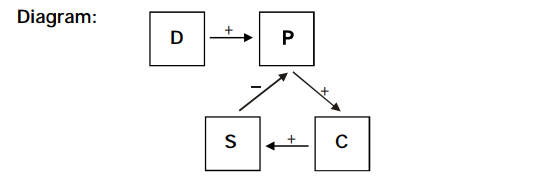
Over the last few years, the demand (D) for PCs rose continuously.
♦ This led to an increase in prices (P).
♦ The general increase in prices led to more and more companies (C) entering the PC market.
♦ As a result, the supply (S) of PCs increased.
♦ This, in turn, affected prices (P): they fell.
Text:
To help understand a text, it makes sense to:
1 ,First read the text.
2, Then make notes.
3, Memorise the content of the text using the notes.
4, Afterwards, try to reproduce the essential content of the text memory.
Diagram: Read text → Make notes → Memorise content → Reproduce content
Notes on Relations
♦ Some relations are shown by other arrows or line connections.
♦ These will be explained in the corresponding exercises.
♦ Each exercise comprises up to three questions on a particular topic.
♦ To solve them, you may need to take account information previous exercises.
For example: Solving Exercise 3 may require information given in Exercises 1 and 2.
♦ If exercises are linked in this way, you will always be informed.
♦ Solve the exercises using only the given information.
♦ Specialist knowledge is not required to solve the exercises correctly.
Sample Question 1 (Degree of Difficulty: Low)
Text:
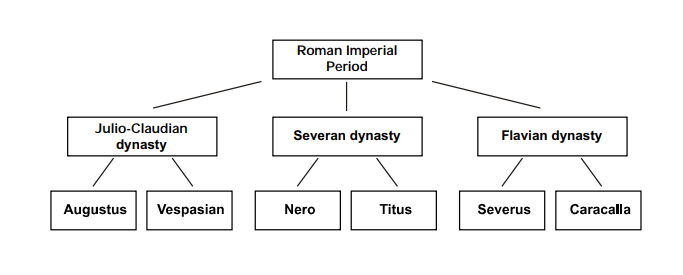
The Roman Imperial Period can be divided three dynasties:
♦ Julio-Claudian dynasty → Augustus, Nero
♦ Flavian dynasty → Vespasian, Titus
♦ Severan dynasty → Severus, Caracalla
Instruction:
The following diagram is intended to show the described affiliations.
Affiliations are shown by connecting lines.
Question:
Which of the following statements is or are correct?
I. The Julio-Claudian dynasty is shown correctly.
II. The Flavian dynasty is shown correctly.
Options:
(A) Only statement I is correct.
(B) Only statement II is correct.
(C) Both statements are correct.
(D) Neither of the two statements is correct.
Sample Question 2 (Degree of Difficulty: Low)
Text:
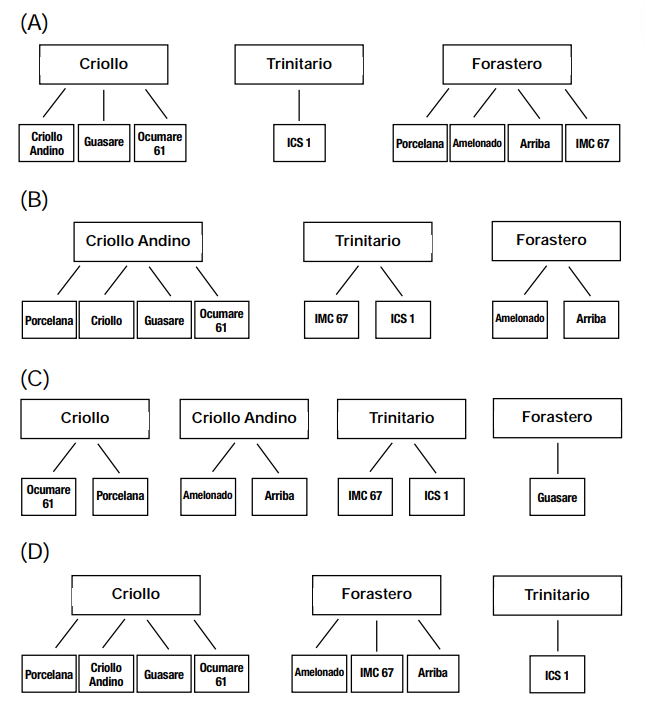
Types of Cocoa – Three main groups of cocoa subspecies:
♦ Criollo (fine cocoa, several subtypes):
Porcelana: smooth fruits, green → red.
Criollo Andino: Merida & Tachira (Venezuelan Andes).
Guasare: grows quickly, fruits after 3 years, strong flavour.
Ocumare 61: widespread in Venezuela, superior flavour & robustness.
Forastero (≈ 80% of worldwide cultivation, resilient, but weaker taste):
♦ Amelonado: most widespread, main type for sellable cocoa.
♦ IMC 67: (Iquitos Mixed Calabacillo 67), global spread, little shade needed.
♦ Arriba: fine taste, flowery flavour.
♦ Trinitario (hybrid variety, high quality):
ICS 1 (Imperial College Selection 1): high-yield (≈100 fruits/year), mild & fruity.
Instruction:
The following diagram is intended to show the classification of cocoa types according to subspecies and their characteristics.
Which of the following diagrams shows the correct allocation of superordinate terms and subordinate terms? Superordinate and subordinate terms are linked together by lines.
Sample question 3: degree of difficulty medium
The Roman Empire
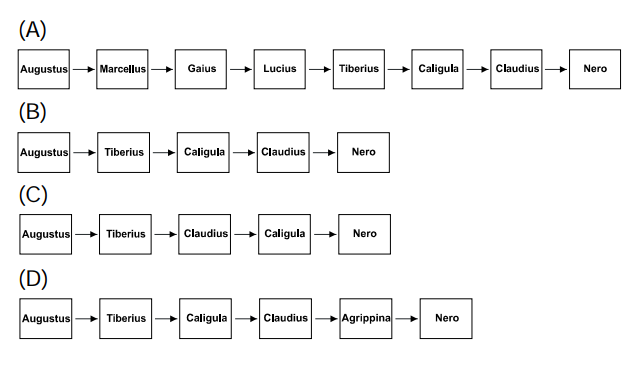
Augustus ruled over the Roman Empire 24 BC to 14 AD. Tiberius, Augustus’ stepson, was initially excluded succession to the throne by Augustus. Only after the death of Augustus’ nephew Marcellus, and the deaths of the two grandsons Gaius and Lucius (neither of whom reigned), did Tiberius come to power in 14 AD. Claudius, initially passed over in Caligula’s favour, was the only legitimate candidate after Caligula’s murder and became emperor. Nero, who became Claudius’ successor through the efforts of his ambitious mother Agrippina, is described by historians as a tyrant and passionate actor who, in fulfilling his role, killed his mother.
Which of the following diagrams correctly shows the imperial succession?
Sample question 4: degree of difficulty medium
Chocolate
A magazine makes the claim:
“Successful people eat dark chocolate to do something for their hearts. Dark chocolate contains more cocoa and hence more antioxidants than light-coloured chocolate. Antioxidants improve the body’s vascular functions for a few hours. The higher the level of education and income, the darker the chocolate.” The following diagram is intended to show the described effects.
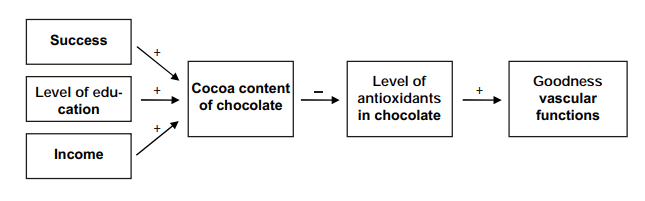
Which of the following two statements about this diagram is or are correct?
I. The diagram correctly shows the effects of education and income on cocoa content in the preferred type of chocolate.The diagram correctly shows the effects of cocoa
II. content in chocolate on the level of antioxidants in chocolate.
(A) Only statement I is correct.
(B) Only statement II is correct.
(C) Both statements are correct.
(D) Neither of the two statements is correct.
Sample question 5: degree of difficulty medium to high
Chocolate and its Effects
Research has shown that eating cocoa-containing chocolate may contribute slightly towards reducing blood pressure. Cocoa-containing chocolate also contains a substance which supports the healing of wounds and reduces the risk of stomach diseases.
How can one show these effects in a diagram?
I. Eating cocoa-containing chocolate is connected to a reduction of blood pressure using . points to reduction of blood pressure.
II. Eating cocoa-containing chocolate is connected to the healing of wounds using and is connected to the risk of stomach diseases using and point to eating cocoa-containing chocolate.
(A) Only statement I is correct.
(B) Only statement II is correct.
(C) Both statements are correct.
(D) Neither of the two statements is correct.
Sample question 6: degree of difficulty high
Arable Farming in the Roman Empire
In the Roman Empire, there was not much fertiliser available in the form of dung for its fields since there were frequently no larger herds of cattle near the farms. The further away the cattle herds were a farm, the less dung was available for the fields. The less dung there was for fertilising, the more frequently the farmers had to let the corn fields rest.
The following diagram shows the effects of the distance of the cattle herds the farm, the availability of fertiliser in the form of dung, and the frequency of resting periods when growing corn crops.
Cattle = distance of the cattle herds the farm Dung = availability of fertiliser in the form of dung
Rest = frequency of resting periods when growing corn crops

If there was less fertiliser in the form of dung, nitrogen-rich plants were cultivated and used as fertiliser. However, due to the low rainfall frequency in the Roman Empire, this was not always possible: The fewer the rainfalls, the less nitrogen-rich plants could be grown. Nevertheless, intensive irrigation significantly increased the cultivation of nitrogen-rich plants and so shortened the resting periods for growing corn.
♦ Cul = cultivation of nitrogen-rich plants
♦ Dung = availability of fertiliser in the form of dung
♦ Irrig = intensity of irrigation
♦ Rain = rainfall frequency
♦ Rest = frequency of resting periods when growing corn crops
What additions have to be made to the diagram to show these effects correctly?
I. Cul is positioned between Dung and Rest and is linked to both by arrows. One arrow points Dung → Cul, another arrow Cul → Rest.
II. Rain and Irrig are each linked to Cul with an arrow. Both arrows point to Cul.
(A) Only statement I is correct.
(B) Only statement II is correct.
(C) Both statements are correct.
(D) Neither of the two statements is correct.
The subtest “Recognising Linguistic Structures” comprises sentences in a fictitious language and their English counterparts. The information provided is to be used to derive the meaning of individual words, semantic relations between the terms, and several grammar rules. Subsequently the newly acquired knowledge is to be used to formulate new sentences in the fictitious language.
♦ the ability to recognise structures and inherent laws in language patterns,
♦ the ability to use these laws in new contexts,
♦ the ability to recognise semantic relations expressed by word order or other linguistic characteristics.
♦ Number of questions: 22
♦ Working time: 50 minutes
♦ Please read the instructions before you start with the examples.
♦ In the following exercises, you will be shown several expressions in invented foreign languages and their English translation.
♦ This will allow you to derive the meaning of individual words and some grammatical rules in the respective foreign language.
♦ This information will help you answer the subsequent questions.
♦ In each case, two exercises relate to a certain language. Therefore, please only use the provided expressions to answer the questions.
You may proceed on the assumption that:
♦ there are no exceptions to the rules (e.g. irregular verbs), and
♦ only those rules apply which may be derived the provided expressions
Given expressions:
♦ koloa = I lie
♦ kolue = he lay
♦ satoe = he stands
Question:
What is “I stood” in the foreign language?
Options:
(A) satoa
(B) kolua
(C) satoe
(D) satua
Answer:
Correct option: (D) satua
Reasoning:
1, The expressions I lie and he lay differ only as regards the last two letters; hence kol must be the root of the verb lie.
2, The final letter of the expressions he lay and he stands is in both cases e; hence an appended e means he.
3, The two present tense forms (I lie and he stands) both have an o as the penultimate letter; hence u as the penultimate letter must indicate the past tense and a as the last letter must mean I.
Consequently: I stood in the foreign language must be satua.
Sample Question 1
Degree of difficulty: Low
Given expressions:
palo ko = I sit
palo tu = she sits
karo tu = she stands
Question:
“I stand” is expressed in the foreign language by:
Options:
(A) tu ko
(B) ko karo
(C) karo ko
(D) karo palo
Sample Question 2
Degree of difficulty: Medium
Given expressions:
tundo ramodopo novot = The pupil called his uncle.
namidu kavino suvavot = The saleswoman greeted the teacher.
tundu kavinopu tetavosir = The schoolgirl is asking her teacher.
hidamo tundo nosir = The caretaker is scolding the pupil.
Question:
“The uncle greeted his caretaker” is expressed in the foreign language by:
Options:
(A) novot suvosir hidamo
(B) namidu hidamopu suvavot
(C) novot hidamopo suvasir
(D) ramodo hidamopo suvavot
Sample Question 3
Degree of difficulty: Medium
Given expressions:
rumpulöpp = The child is sleeping.
renguming tschik löppzi = The person is protecting his child.
rumpilemp gum = The goat is sleeping deeply.
yanitzorr lempzi = The lion is killing the goat.
Question:
“The child is protecting his goat” is expressed in the foreign language by:
Options:
(A) rumpulemp tschik rengzi
(B) rengilöpp tschik lempzi
(C) rumpilemp tschik löppzi
(D) rengulöpp tschik lempzi
Sample Question 4
Degree of difficulty: Medium to High
Given expressions:
puna selveui = The child is coming the hut.
puna tipveu = The cat is going to the hut.
lom fanveui = The farmer is coming the field.
borro selveu = The child is walking to the meadow.
Question:
“The child is walking to the field” is expressed in the foreign language by:
Options:
(A) lom selveui
(B) lom selveu
(C) lom fanveu
(D) puna selveu
Sample Question 5
Degree of difficulty: Medium to High
Given expressions:
po namal = He learns everything.
su ?mal = You will learn.
ki ?malna = I will learn nothing.
lemal rah malle su = Are you learning a lot or a little?
?nafor ak = Will we ask everything?
Question:
“Will he learn a little?” is expressed in the foreign language by:
Options:
(A) po malle
(B) ?lemal po
(C) ?malle po
(D) po ?lema
Sample Question 6
Degree of difficulty: High
Given expressions:
ao tane lom sok bani jo sharuli = He spoke on the radio yesterday.
ao hai lom yal bani ao lanta = He will learn to program tomorrow.
ao simi kiso jo fesomo ao hai = You are sitting at university and learning.
ao rumi lom shili jo fesomo = I am listening at university today.
Question:
“I speak and listen” is expressed in the foreign language by:
Options:
(A) ao tane shili ao rumi
(B) shili tane ao rumi
(C) ao tane lom jo rumi
(D) tane ao rumi lom
Bài thi Humanities, Cultural Studies and Social Sciences Module trong TestAS không chỉ đánh giá năng lực ngôn ngữ, tư duy logic và khả năng phân tích của thí sinh, mà còn phản ánh sự chuẩn bị học thuật cần thiết trước khi bước vào môi trường đại học tại Đức. Việc nắm vững cấu trúc đề thi và rèn luyện qua các dạng câu hỏi mẫu sẽ giúp bạn làm quen với cách ra đề, từ đó tự tin hơn trong quá trình làm bài.
Nếu bạn đang có kế hoạch du học Đức, hãy lên lộ trình ôn luyện sớm, tập trung vào việc phát triển tư duy phản biện, khả năng diễn đạt và phân tích thông tin. Chuẩn bị kỹ càng ngay từ bây giờ sẽ là chìa khóa giúp bạn đạt kết quả cao trong kỳ thi TestAS và mở rộng cánh cửa đến với những trường đại học mơ ước.
>>> Nhiều người quan tâm: DU HỌC THẠC SĨ TẠI ĐỨC BẰNG TIẾNG ĐỨC/ TIẾNG ANH - MIỄN 100% HỌC PHÍ

Hoặc gọi trực tiếp đến hotline (điện thoại/zalo) để được tư vấn nhanh nhất

Mọi chi tiết xin liên hệ:
Công Ty Tư Vấn Du Học Và Đào Tạo CHD
VP Hà Nội: 217 Nguyễn Ngọc Nại, Quận Thanh Xuân
Hotline: 0975.576.951 – 0913.839.516
——————————————————————
VP Hồ Chí Minh: Tầng 1 Quốc Cường Building, số 57, đường Bàu Cát 6, phường 14, Tân Bình
Hotline: 0913.134.293 – 0973.560.696
——————————————————————
Email: duhocchdgood@gmail.com
Website: duhocchd.edu.vn
Facebook: facebook.com/TuVanDuHoc.CHD/
Instagram: chd_education
Tiktok: chd_education









TVQuản trị viênQuản trị viên
Xin chào quý khách. Quý khách hãy để lại bình luận, chúng tôi sẽ phản hồi sớm