
.jpg)
Nếu bạn đang chuẩn bị cho kỳ thi TestAS – bài kiểm tra năng lực học thuật dành cho sinh viên quốc tế tại Đức – thì phần Sample Questions (câu hỏi minh họa) chính là công cụ không thể thiếu. Đây không chỉ là tài liệu giúp bạn hiểu cấu trúc đề thi, mà còn là cơ hội để bạn làm quen với cách ra đề, mức độ khó và chiến lược làm bài.
Core Test là phần bắt buộc đối với tất cả thí sinh và phải được hoàn thành trước tiên. Bài thi này được chia thành 4 bài thi nhỏ (subtest) với tổng thời gian làm bài là 110 phút:
♦ Giải quyết vấn đề định lượng (Solving Quantitative Problems): 22 câu – 45 phút
♦ Suy luận mối quan hệ (Inferring Relationships): 22 câu – 10 phút
♦ Hoàn thành mẫu hình (Completing Patterns): 22 câu – 20 phút + 5 phút đọc hướng dẫn
♦ Tiếp tục chuỗi số (Continuing Numerical Series): 22 câu – 25 phút + 5 phút đọc hướng dẫn
Trong tài liệu chính thức, bạn sẽ được cung cấp 6 câu hỏi minh họa cho mỗi bài thi nhỏ. Các câu hỏi được sắp xếp từ dễ đến khó, giúp bạn rèn luyện dần dần và nâng cao kỹ năng.
Ở phần mở đầu của từng bài thi nhỏ, luôn có giới thiệu ngắn gọn về dạng câu hỏi và hướng dẫn cách giải. Đây chính là chìa khóa để bạn hiểu rõ yêu cầu và tránh mất thời gian khi bước vào bài thi thật.
>>> Xem thêm: DU HỌC ĐỨC NÊN CHỌN TRƯỜNG NÀO? TOP 10 TRƯỜNG ĐẠI HỌC HÀNG ĐẦU TẠI ĐỨC CHO SINH VIÊN QUỐC TẾ
The subtest “Solving Quantitative Problems” provides practical problems to be solved by using basic arithmetic operations.
♦ This test measures mathematical thought and the ability to solve basic mathematical problems.
♦ The level of arithmetic operations is elementary.
♦ 22 questions in the test
♦ Working time: 45 minutes
Please read the instructions before you start with the examples.
Here you will find some problems which you have to solve.
Example
Task:
A student works in a factory during the holidays. He earns 10 Euros an hour. He works 8 hours a day, 5 days a week. How much money has he earned at the end of 4 weeks of work?
Options:
(A) 800 Euros
(B) 1,200 Euros
(C) 1,600 Euros
(D) 2,000 Euros
Answer: (C) 1,600 Euros
Solution steps:
♦ Daily wage = 10 Euros × 8 hours
♦ Weekly wage = Daily wage × 5 days
♦ Wage after 4 weeks = Weekly wage × 4 weeks
Sample Questions
Sample Question 1 – difficulty: low
2,600 bottles contain 650 litres of a soft drink. How many litres do 5,000 bottles hold?
(A) 338 litres
(B) 1,000 litres
(C) 1,250 litres
(D) 1,300 litres
Sample Question 2 – difficulty: low
A working day is 8 hours long and a working week is five days long. A woman receives a wage of 25 Euros per hour. If she works for longer than 8 hours per day, she receives 30 Euros for each extra hour. In 4 weeks, she earns 4,600 Euros.
How many hours did she work altogether in those four weeks?
(A) 195
(B) 180
(C) 175
(D) 160
Sample Question 3 – difficulty: medium
Corinna has a photo which is 9 cm wide and 6 cm high. She would like to enlarge it to a width of 15 cm. The ratio of width to height has to remain the same. How high will the photo be?
(A) 11 cm
(B) 10 cm
(C) 9 cm
(D) 8 cm
Sample Question 4 – difficulty: medium
Dora and her three siblings Anton, Berta and Carl are an average of 5 years old. Anton is 2, Berta 6 and Carl 7. Dora, her cousin Hanna, Hanna's brother Emil (18), Hanna's sister Franka (6) and Hanna's brother Gustav (1) are an average of 10 years old.
How old is Dora's cousin Hanna?
(A) 5
(B) 10
(C) 15
(D) 20
Sample Question 5 – difficulty: high
Together, two sports clubs (A and B) have x members; A has a members and B has b members. Some of the persons are members of both sports clubs. Which of the following expressions describes how many persons are members in only one of the two sports clubs?
(A) x + a – b
(B) 2(a + b) – 2x
(C) ab – 2x
(D) 2x – (a + b)
Sample Question 6 – difficulty: high
A bottle X is filled entirely with orange juice. It contains 1 l of orange juice. Maria pours orange juice this bottle X two empty bottles Y and Z. Bottle Y is half as big as bottle X (in terms of volume). After the filling operation:
♦ Bottle X still contains 0.6 l of orange juice
♦ Bottle Y is 1/5 full of orange juice
♦ Bottle Z is half-full of orange juice
Then Maria fills bottle Z with water until it is full.
How much liquid does bottle Z contain?
(A) 0.1 l
(B) 0.3 l
(C) 0.4 l
(D) 0.6 l
In the subtest “Inferring Relationships”, each question consists of two pairs of words. Two of the four words are missing, and you are to identify the matching words so that both pairs of words have an analogous (the same, similar) relationship.
This requires that you:
♦ Find the rule governing the analogy.
♦ the words accordingly.
This test measures logical linguistic thought. Test takers have to:
♦ Identify meaning.
♦ Generalise and abstract in order to find the rule.
♦ Concretise the rule in order to fill the gaps.
♦ Number of questions: 22
♦ Working time: 10 minutes
2.2 Instructions
Please read the instructions before you start with the examples.
Example of analogy:
“Dark : light = hot : cold”
♦ “dark” is the opposite of “light”.
♦ “hot” is the opposite of “cold”.
♦ Therefore, there is an analogous relationship between both pairs.
Each problem contains two gaps.
♦ Your task is to fill the two gaps in such a way that the analogy is correct on both sides of the “=”.
♦ The order of words matters: whether a word comes before or after the colon “:” is decisive.
house : ______ = tree : ______
Options:
(A) window – apple tree
(B) villa – tree trunk
(C) roof – branch
(D) front door – furniture
Correct answer: (C) roof – branch
♦ A roof is part of a house.
♦ A branch is part of a tree.
Note:
♦ The first word always goes in the first space.
♦ The second word always goes in the second space.
♦ All verbs are expressed as “to” + infinitive (e.g. to drink).
♦ If a word can be a noun or a verb and appears without “to”, it is meant as a noun (e.g. “drink” = beverage).
Sample Questions
Sample question 1 – difficulty: low
pear : fruit = ______ : ______
(A) motor – motorcycle
(B) hammer – tool
(C) grass – cow
(D) animal – elephant
Sample question 2 – difficulty: low
to cut : ______ = ______ : ball
(A) sharp – round
(B) bread – football
(C) knife – to play
(D) blood – to throw
Sample question 3 – difficulty: medium
warmth : ______ = wind : ______
(A) temperature – tornado
(B) cold – wind velocity
(C) flame – rain
(D) heat – storm
Sample question 4 – difficulty: medium
thick : thin = ______ : ______
(A) tired – sleepy
(B) sad – happy
(C) warm – hot
(D) hungry – thirsty
Sample question 5 – difficulty: high
diversity : ______ = ______ : action
(A) uniformity – success
(B) distance – passiveness
(C) variety – deed
(D) uniformity – measure
Sample question 6 – difficulty: high
intentional : ______ = coincidental : ______
(A) purposeful – unplanned
(B) unintentional – unplanned
(C) planned – chaotic
(D) orderly – disorderly
In the subtest “Completing Patterns”, lines, circles, quadrilaterals and other geometrical shapes are arranged in the fields of a matrix according to a specific rule.
♦ You must find the rule and apply it by identifying the missing shape in the last field.
♦ This test measures logical graphic thought.
♦ Language skills or educational background are irrelevant.
♦ Number of questions: 22
♦ Working time: 20 minutes
Please read the instructions before you start with the examples.
For this group of items:
♦ You will read the instructions before the working time begins.
♦ The working time starts only after the instructions have been read.
♦ The test administrator will tell you when to begin.
♦ Each item consists of nine fields.
♦ Eight of the fields contain figures.
♦ The ninth field (bottom right) contains a question mark.
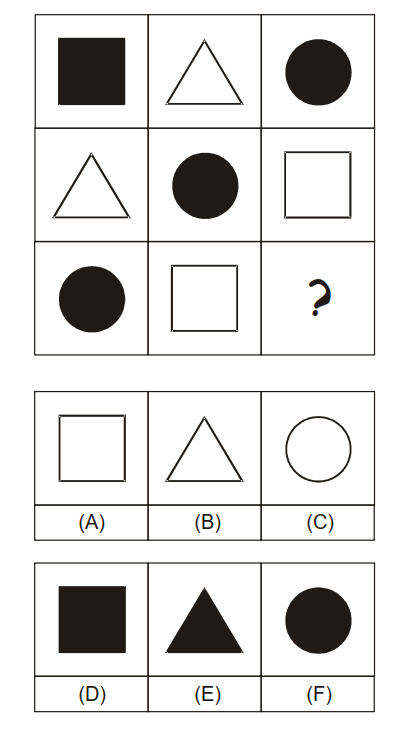
♦ Your task: recognise these rules and apply them to find the ninth figure.
Rules of Arrangement
The rules may apply:
♦ to right,
♦ OR top to bottom,
♦ OR to right AND top to bottom.
Important: There are no diagonal rules.
♦ To solve an item, you may need one, two, or three rules.
♦ It is also possible that one rule applies horizontally and another vertically.
Answer Options
♦ Below the nine fields, you will find six figures (A, B, C, D, E, F).
♦ the figure which should replace the question mark.
The explanation of how to reach the solution is given in sample question 3.
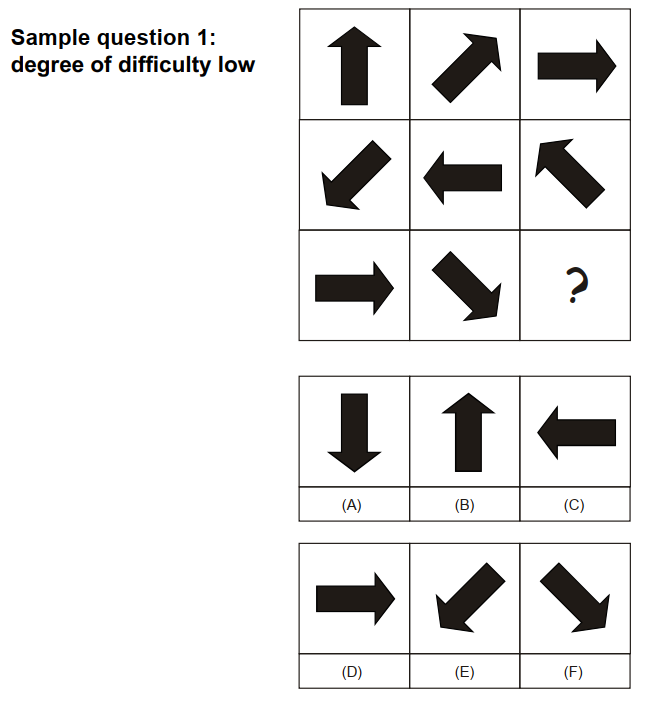
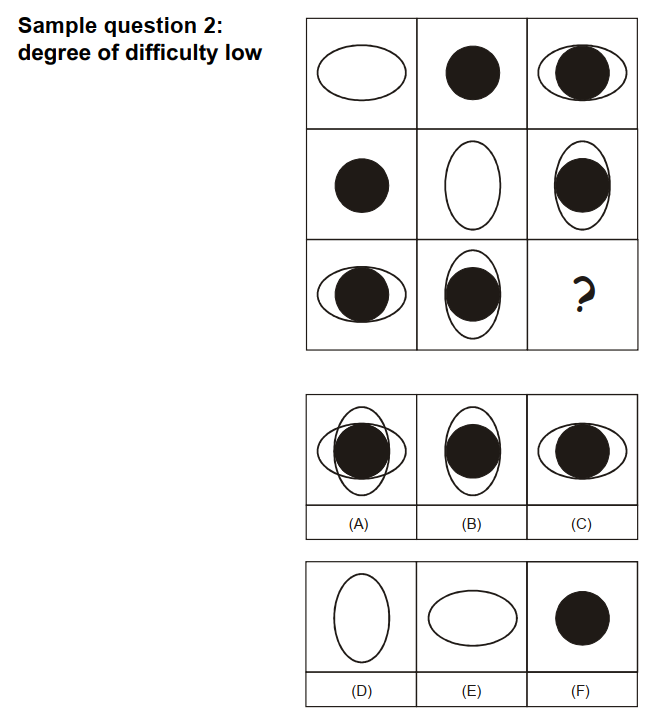
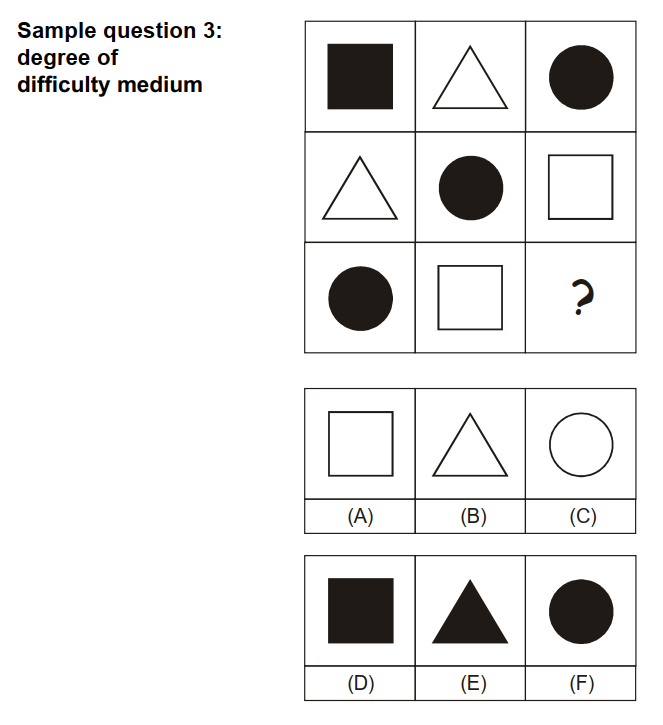
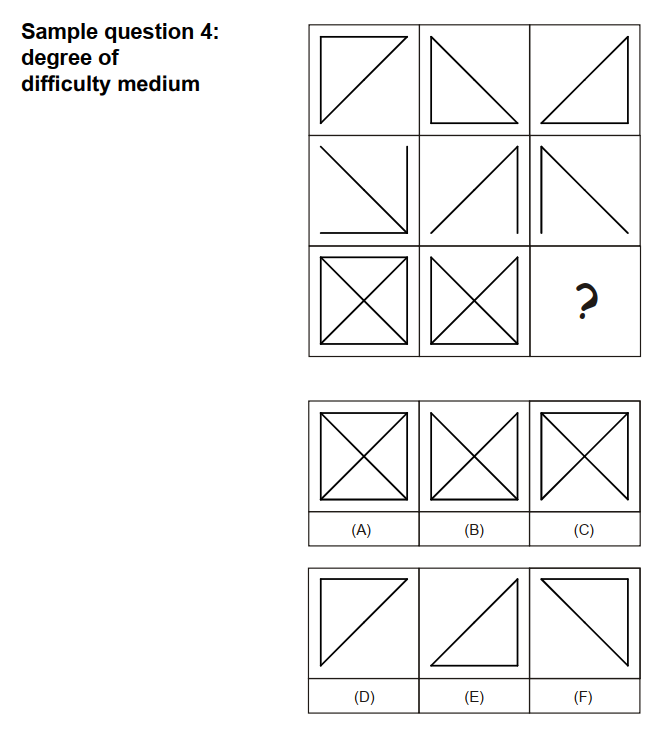
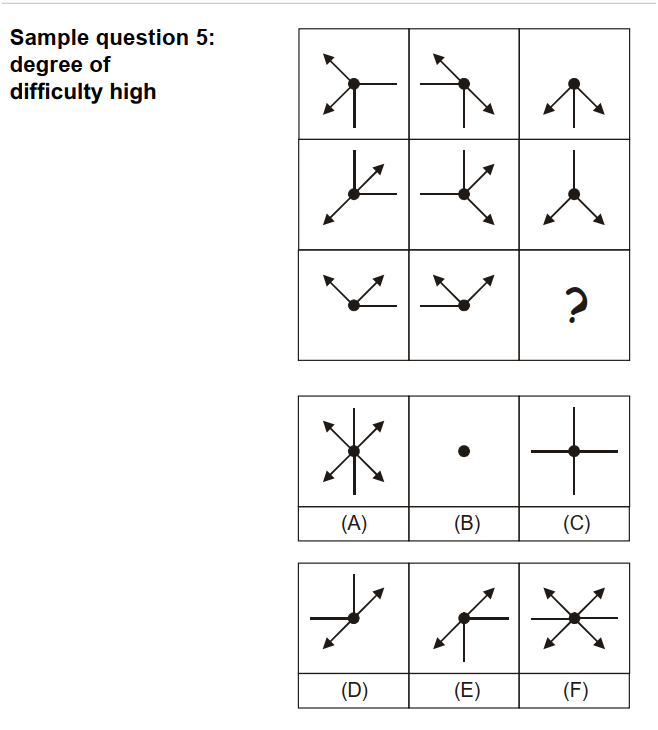
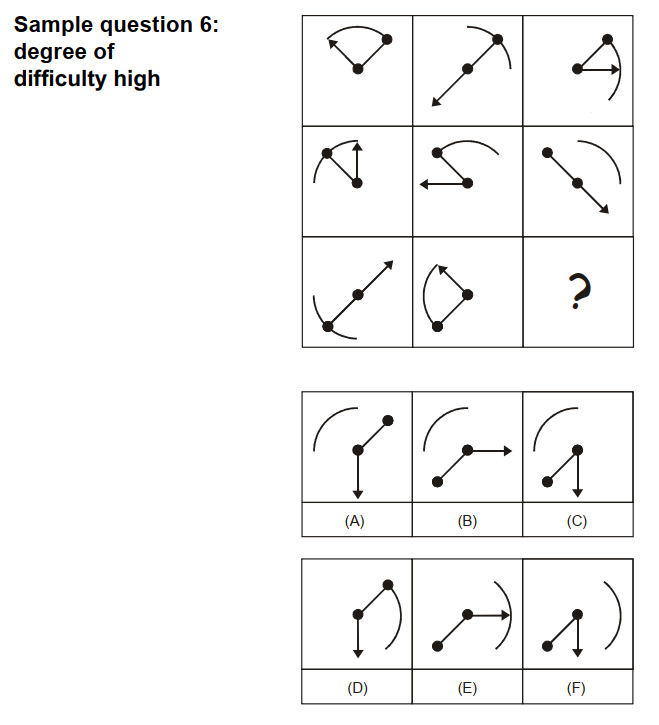
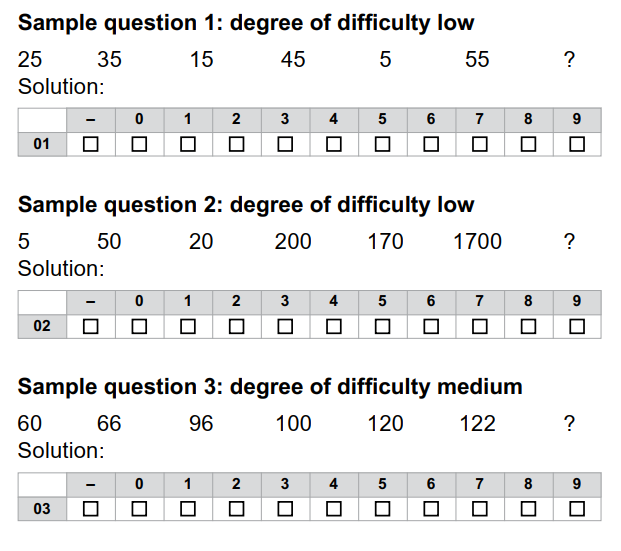
The subtest “Continuing Numerical Series” presents a sequence of numbers formed according to a specific rule. Your task is to identify that rule and apply it to find the missing number.
♦ This test measures logical numerical thought.
♦ Only the four basic arithmetical operations — addition (+), subtraction (−), multiplication (×) and division (÷) — are required.
♦ Number of questions: 22
♦ Working time: 25 minutes
♦ Please read the instructions before you start with the examples.
♦ For this group of items, you will read the instructions before the working time begins. The working time does not start until after the instructions have been read. The test administrator will tell you when to begin.
♦ Each item consists of a numerical series; the next number in the series is marked by a question mark (?).
♦ Your task: determine the rule that generates the series and calculate the number that should replace (?).
♦ Each rule may contain only the four basic operations (+, −, ×, ÷).
Example 1
Series: 5 15 13 23 21 31 29 ?
Rule: +10, −2, +10, −2, +10, −2
Calculation:
♦ 5 + 10 = 15
♦ 15 − 2 = 13
♦ 13 + 10 = 23
♦ …
♦ 29 + 10 = 39
So the missing number is 39.
Example 2
Series: 35 30 120 60 55 220 110 ?
Rule: −5, ×4, ÷2, −5, ×4, ÷2
Calculation:
♦ 35 − 5 = 30
♦ 30 × 4 = 120
♦ 120 ÷ 2 = 60
♦ 60 − 5 = 55
♦ 55 × 4 = 220
♦ 220 ÷ 2 = 110
♦ 110 − 5 = 105
So the missing number is 105.
♦ 1. Scan the numerical series to see obvious patterns (alternating operations, repeating blocks, multiplicative steps, etc.).
♦ 2. Determine the rule that fits the observed numbers (combination of +, −, ×, ÷).
♦ 3. Apply the rule to compute the next term — carry out the arithmetic and enter the whole-number result.
♦ The solution number is always a whole number (it can be positive, negative or zero).
♦ No digit repeats within a solution number (e.g., 11, 44 or 100 will not occur).
♦ On the answer sheet, mark the individual digits that compose the solution number.
• If the number is negative, also mark the “−” sign on the answer sheet.
• The order of the digits on the answer sheet does not matter.
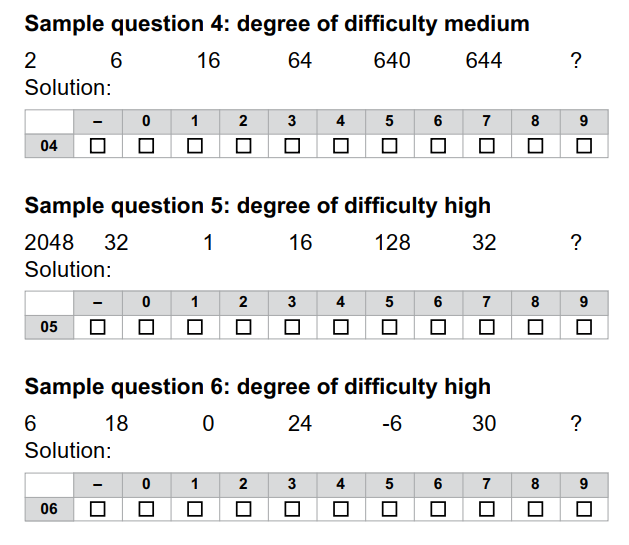
Trên đây là mẫu đề minh họa, để đạt kết quả cao, bạn nên: Luyện tập đúng giới hạn thời gian từng phần; ôn tập đều cả 4 subtest, không bỏ qua phần nào và rút kinh nghiệm sau mỗi lần luyện để cải thiện tốc độ và độ chính xác.
Việc luyện tập với Sample Questions của TestAS không chỉ giúp bạn làm quen với cấu trúc đề thi mà còn rèn luyện tư duy logic, khả năng phân tích và quản lý thời gian – những yếu tố quyết định thành công trong kỳ thi thật.
>>> Nhiều người quan tâm: DU HỌC THẠC SĨ TẠI ĐỨC BẰNG TIẾNG ĐỨC/ TIẾNG ANH - MIỄN 100% HỌC PHÍ
Hoặc gọi trực tiếp đến hotline (điện thoại/zalo) để được tư vấn nhanh nhất

Mọi chi tiết xin liên hệ:
Công Ty Tư Vấn Du Học Và Đào Tạo CHD
VP Hà Nội: 217 Nguyễn Ngọc Nại, Quận Thanh Xuân
Hotline: 0975.576.951 – 0913.839.516
——————————————————————
VP Hồ Chí Minh: Tầng 1 Quốc Cường Building, số 57, đường Bàu Cát 6, phường 14, Tân Bình
Hotline: 0913.134.293 – 0973.560.696
——————————————————————
Email: duhocchdgood@gmail.com
Website: duhocchd.edu.vn
Facebook: facebook.com/TuVanDuHoc.CHD/
Instagram: chd_education
Tiktok: chd_education









TVQuản trị viênQuản trị viên
Xin chào quý khách. Quý khách hãy để lại bình luận, chúng tôi sẽ phản hồi sớm